How to price a deck job in New Zealand
How NZ builders price a deck: materials from the frame up, labour by stage, when F4 needs a barrier, when consent applies, and what to exclude.
Last updated
Price a deck in two halves: the materials, counted from the frame up, and the labour, worked out stage by stage rather than as a flat day rate. Then write down what the price leaves out, because a barrier, a ledger detail or a consent fee nobody mentioned is what you end up arguing about later.
What goes into a deck quote?
Start with the frame: piles or posts and the concrete to set them, bearers, joists and blocking, plus the hardware that joins them: saddles, wire dogs or bolts, depending on how the piles are fixed. Then the decking boards and the screws to fix them.
If the deck is attached to the house, add the ledger connection: the ledger board, joist hangers and their nails, coach screws into the framing, and packers for the drainage gap. The weatherproofing at the ledger (sealing washers, flashing tape, a head flashing, sealant) is easy to leave out, so price each item or say plainly that it is excluded.
Then the parts that depend on the job: a balustrade (posts, capping, rails, balusters and their fixings), stairs, a finish such as decking oil, fascia or picture-frame boards, and weed mat and drainage metal underneath. Allow for plant (a concrete mixer, and an auger on a deck with a lot of piles) and for delivery, which is easy to forget.
The decking calculator counts boards, fixings and a cut list, the post hole calculator works out concrete per post, and the balustrade calculator and stair calculator cover those parts.
How do you work out the labour on a deck?
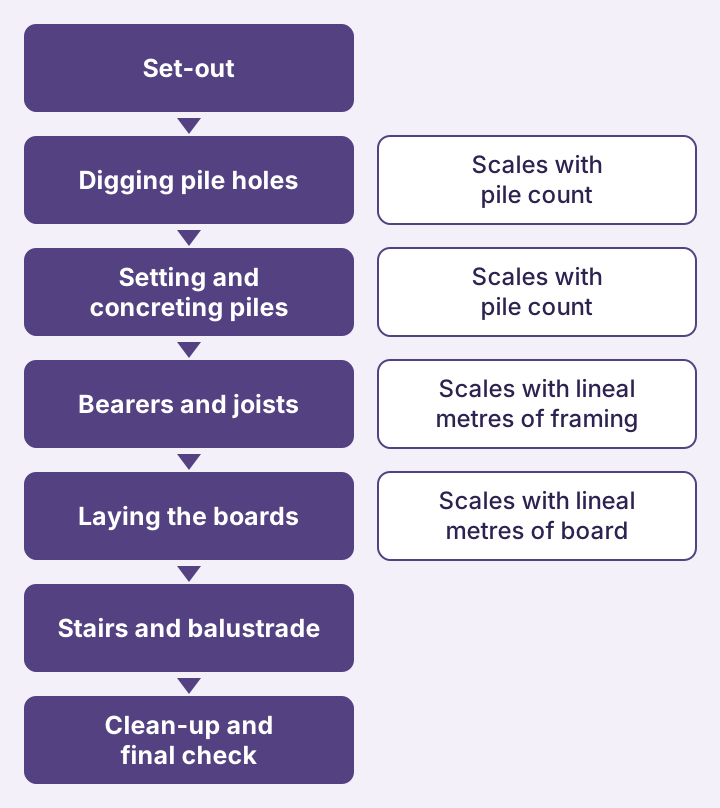
By stage. Set-out, digging pile holes, setting and concreting piles, bearers and joists, laying the boards, stairs and balustrade, and the clean-up and final check each take different time, and they scale with different things: pile count, lineal metres of framing, lineal metres of board.
Then adjust for the site. Difficult access, a sloping section, a high deck, winter weather and the size of your crew all change how long the same deck takes. Board material matters too, but to the board-laying stage, not the framing.
Keep the hours on the page by stage. The client can see where the time goes, and when the job is done you can compare each stage against what it actually took.
When does a deck need a balustrade?
Under NZ Building Code clause F4, a barrier is needed where a fall of 1.0m or more is possible. So measure the fall at the highest edge of the deck, not the average height. A deck that is 0.8m at one end and 1.1m at the other needs a barrier on the high side.
If the quote does not include a balustrade, say so in writing, and if the deck is over the threshold, say that one is required. Allow for edge protection while you build a high deck, too; it is easy to leave out of the price.
Does a deck need building consent?
Many do not. Schedule 1 of the Building Act 2004 exempts a deck from building consent where it is not possible to fall more than 1.5m from it, among other conditions. Above that, check with your council before you quote, and keep consent fees and any engineering out of the price unless you have actually priced them.
Things that push a deck outside a simple job and towards an engineer: a spa or anything holding water, a deck on soft or uncertain ground, a roof over it, cantilevers, or a design load above the standard residential floor load. Member sizes and pile spacing are B1 (Structure) decisions: take them from your plans or your engineer.
What should a deck quote exclude?
Write the exclusions down, every time. The usual ones: gates and gate hardware; landscaping, planting or lawn reinstatement around the deck; outdoor lighting, power or any electrical work; screening, privacy panels or a pergola over the deck; building consent fees where the deck is not exempt; and delivery or cartage unless it is its own line.
Also exclude, or price, the finish (oil or stain), the balustrade if you have not priced one, any ledger weatherproofing you have left out, and on a re-deck, rotten framing you cannot see yet. Ground conditions belong in the assumptions: soft clay, a high water table or rock can mean deeper or larger footings than planned.
Is a re-deck priced differently?
Yes. If you are stripping the boards and keeping the existing frame, the piles, bearers, joists, blocking and ledger drop out of the materials, and the labour is removal and disposal plus new boards. The risk moves to what is under the old boards: allow for a number of rotten joists, or state that replacing damaged framing is a variation.
On an older house, ask whether it was built before 2000 before you quote any demolition, and treat what you find accordingly: the free asbestos risk tool walks through the questions.
What about treatment and fixings near the coast?
Match the treatment grade to the exposure: H3.2 for above-ground framing and decking, and in-ground grades for posts and piles, per clause B2 (Durability). Within about 500m of the coast or a harbour, specify stainless fixings and check the grade against B2/AS1. It changes the price of every screw, nail, bolt and bracket on the job.
Can software price a deck for me?
CostMate builds a deck estimate from the size, height, pile method, board choice and site conditions you enter: the materials line by line, the labour by stage, and the assumptions and exclusions, priced from Dayle ITM and PlaceMakers trade pricing or your own supplier pricing. There is a free plan and no card to start.
Already quoted a deck? The free Quote Checker is there for a second look, no sign-up needed.
Before you quote, confirm barrier heights, treatment and fixing grades and consent against the NZ Building Code and your council, and member sizes against your plans or engineer.
Price your own deck job Free to start. No credit card required. Start free