How to price a driveway in New Zealand
How NZ builders price a concrete driveway: your ground work and boxing vs the concreter's pour, quantities, labour by stage, crossings and consent.
Last updated
A concrete driveway quote is two jobs in one. There is the ground work and boxing you do yourself, and the concrete your concreter places and finishes. The area drives most of the price. The edge length, the ground and who places the concrete move it just as much. Price your part, get your concreter's number for theirs, and keep the two apart so nothing is charged twice.
What goes into a driveway quote?
Your side of it: set-out, levels and falls; digging out to the subgrade; the basecourse, laid and compacted; a polythene slip layer; the edge boxing, pegged; and the reinforcing mesh, on chairs. Allow for site setup and protection, clean-up and the rubbish, and the plant: a plate compactor, and a digger if the ground is hard or soft.
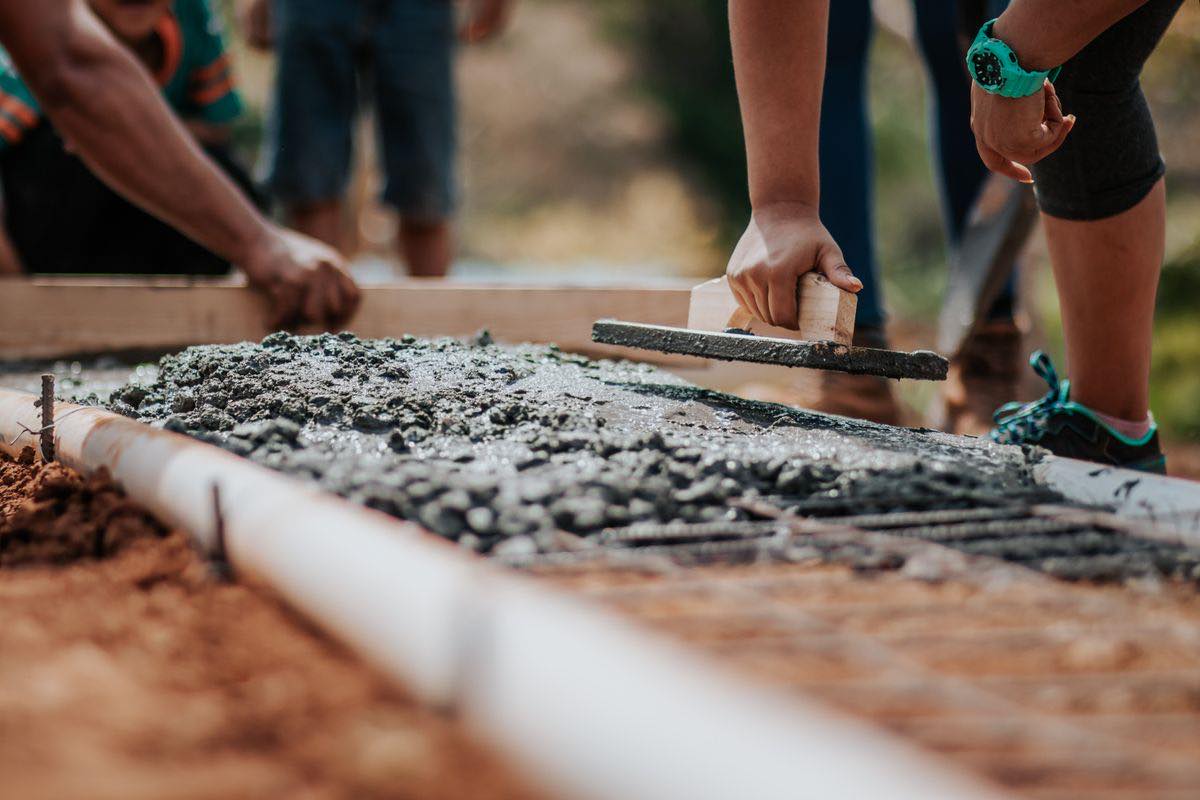
The concrete side: the ready-mix, placing, screeding, the finish, the saw-cut control joints and curing. Add any kerb and channel along the boundary, and a channel drain across the drive where water needs catching before it reaches the garage or the house.
Who places the concrete, you or your concreter?
On most driveways the concreter places, screeds, finishes and saw-cuts the concrete. The builder does the set-out, boxing, basecourse and mesh. Placing and finishing is its own trade, with its own qualification, so price it the way you will actually run the job.
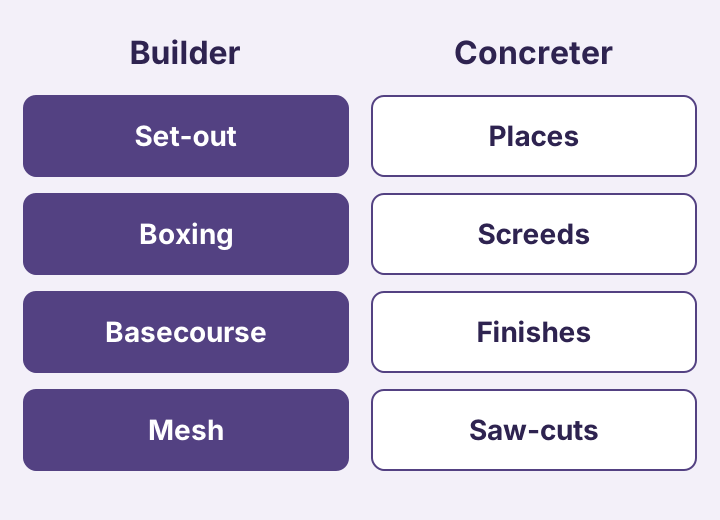
If your concreter is placing, leave the pour, finish and saw-cut hours out of your own labour. Carrying them in your hours and again in the concreter's price is the easiest way to over-price a driveway. Check what the concreter's price covers: the pump, the saw cuts, curing, travel and establishment are often priced separately.
Settle who orders the ready-mix. If you order it, it is your line, priced from your supplier by volume. If the concreter supplies and places, it is in their price, so do not carry it again.
How do you work out the quantities?
Concrete by volume: the area times the thickness, plus an allowance for waste and a subgrade that is never perfectly flat. Mesh in whole sheets, after the laps, with chairs to hold it at the right cover. Basecourse over the area at the depth you are laying it.
Measure the edge, do not guess it. The boxing and the saw cuts follow the edge length, and a long, narrow drive has a lot more edge than a square pad of the same area. Count the pegs along it.
The concrete calculator works out the volume, bags and mesh, and the fall and gradient calculator gives you the total drop over the length of the drive.
What about thickness and mesh?
The slab has to suit the vehicles on it. A drive for heavier vehicles needs a thicker slab, heavier mesh and deeper boxing, and that changes the concrete volume, the mesh and the boxing timber together. Confirm the thickness and mesh with your designer or concreter, and price all three at that thickness.
What if it is asphalt, pavers or gravel?
Then the concrete stages come off: no mesh, no pour and finish, no saw cuts. Asphalt is normally laid by an asphalt contractor, so get their price for the area. Pavers need bedding sand, screeding, laying, compacting and an edge restraint as well as the pavers themselves. A gravel drive is the gravel plus spreading and compacting it. The set-out, digging and basecourse are still yours in every case.
How do you work out the labour on a driveway?
By stage. Set-out; excavation and subgrade; basecourse and compaction; boxing; mesh; and clean-up. If your own crew places the concrete, add the pour and finish, and the saw cuts and curing. Most stages scale with the area; the boxing and the saw cuts scale with the edge.
Then adjust for the site. Rock or soft clay slows the dig and can mean a digger and extra basecourse. Access for the concrete truck and the digger, the slope of the section, the weather and the size of your crew all change how long the same drive takes. Concrete is not poured in the rain, so allow for the wait.
Does a driveway need consent or council approval?
Ask your building consent authority and your council before you quote. The consent questions are usually about what comes with the driveway rather than the slab itself: where the stormwater goes, under clause E1 (Surface water), any retaining alongside the drive, under B1 (Structure), and any drainage such as a cesspit. Adding hard surface can also raise a stormwater question with the council.
A new or changed vehicle crossing onto the road needs approval from the council or road controlling authority before work starts. In Auckland that is Auckland Transport, which inspects the boxing before the concrete is poured, so build that inspection into your programme. A driveway shared by several properties can need its own council engineering approval. Keep all of those fees out of your price unless you have priced them.
What should a driveway quote exclude?
Write the exclusions down. The usual ones: traffic management where the work affects the road, footpath or berm; reinstating lawn, planting, irrigation or fencing disturbed by the work; retaining or stabilising a bank alongside the drive; locating, moving or relocating services found in the line of the drive; carting away and tipping the spoil if you have not priced it; delivery and cartage unless it is its own line; council fees, the vehicle crossing and any stormwater connection if you have not priced them; and the concreter's price if it is not in yours.
Can software price a driveway for me?
CostMate asks who places the concrete and who orders the ready-mix. It then prices your side line by line: the basecourse, the slip layer, the mesh in whole sheets and the boxing. The ready-mix is listed by volume, at your supplier's price where your pricing has one. When your concreter places, the pour and finish hours come off your labour, and the concreter's work is listed as "price needed" until you enter their number. Asphalt and gravel surfaces and paver laying are listed the same way. In Auckland, the vehicle crossing application fee sits alongside as a separate allowance. Materials are priced from Dayle ITM and PlaceMakers trade pricing or your own supplier pricing, and there is a free plan with no card to start.
Put a real number against every line it leaves for you to price.
Have a driveway quote written up? The free Quote Checker is there for a second look, and you don't need to sign up.
Before you quote, confirm the thickness, mesh and falls with your designer or concreter, the stormwater with your council, and any vehicle crossing with the council or road controlling authority.
Price your own driveway job Free to start. No credit card required. Start free