How to price a fence job in New Zealand
How NZ builders price a paling fence: posts and footings, labour by stage, gates, boundary fences, when consent applies, and what to exclude.
Last updated
A timber paling fence is priced from the posts out: how many posts, how deep they go, and how much concrete each hole takes, then the rails, the palings and the fixings. The labour follows the same order. Counting the fence is the easy bit. The risk is in what's around it: gates, the boundary, the old fence and the ground.
What goes into a fence quote?
Posts and the concrete to set them, rails, palings, the nails that fix the palings and the screws that fix the rails to the posts.

Measure the whole run post to post, and decide how gate openings are handled: either deduct them from the rails and palings and price each gate on its own, or say that the run is priced through the openings.
Then the extras that are specific to the site: taking out the old fence and disposing of it, and on a long run, a post hole borer. Delivery is easy to forget; either price it or exclude it.
The fence calculator counts posts, rails, palings and concrete for a run, and the post hole calculator works out concrete per hole.
How deep do fence posts go?
Deeper where the ground and the fence ask for it. Soft ground (clay, sand, peat or fill), a sloping line, a coastal site and a taller fence all push the footing deeper, which means longer posts and more concrete per hole.
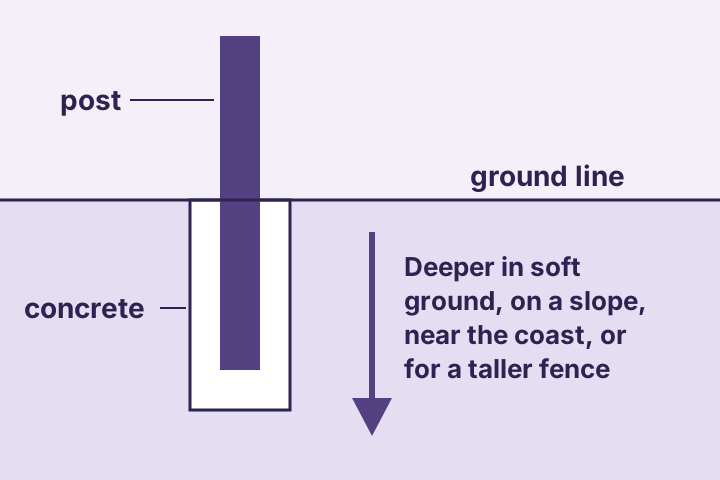
CostMate's footing rule sets embedment between a third and a half of the fence height depending on how many of those apply.
A deeper footing changes three lines at once: the post length you order, the concrete per hole, and the time it takes to dig. Price all three, not just the post.
Rock is different. Drilling or coring rock is specialist work; price it separately or exclude it, rather than hoping the auger gets through.
How do you work out the labour on a fence?
By stage: set-out and the string line, digging and concreting the post holes, fixing the rails, fixing the palings, and the clean-up.
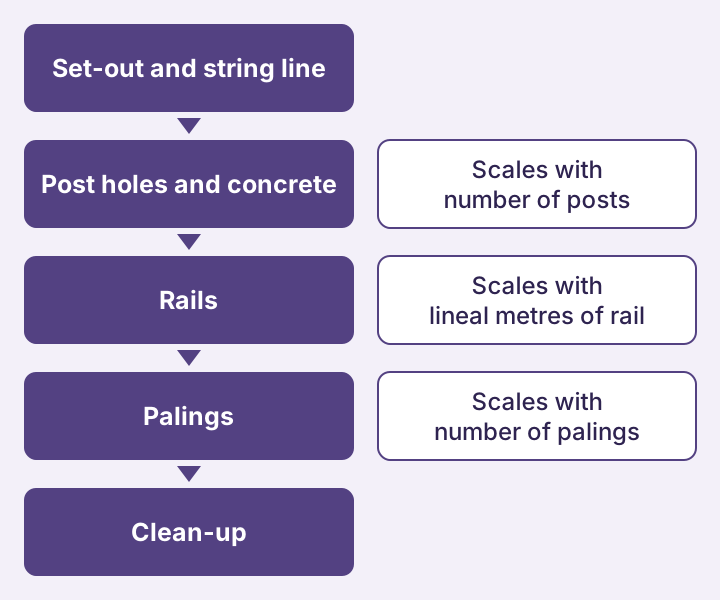
Post holes scale with the number of posts, rails with the lineal metres of rail, and palings with the number of palings, so a board-on-board fence, which uses twice the palings, takes longer to clad than a butted one of the same length.
Then adjust for the site. Difficult access, a sloping line, hard or soft ground, winter weather and the size of your crew all change how long the same fence takes. Hardwood palings take longer to fix than pine.
How should you price gates?
As their own item. A gate is a leaf, heavier posts on bigger footings, framing and the time to hang and adjust it, as well as the hinges, latch and drop bolt. If your quote carries only a hardware allowance for gates, say that the leaf, the gate posts and the hanging are not included.
Who pays for a boundary fence?
That is between the neighbours, under the Fencing Act 1978, not something your quote should decide. State in writing that the boundary location, neighbour approvals and any shared-cost arrangement are excluded unless confirmed.
Set the fence out from a line you have been given, and say so. If nobody is sure where the boundary is, a surveyor's peg-out comes before the fence, and it is not in your price.
Does a fence need building consent?
Most residential fences do not. Schedule 1 of the Building Act 2004 exempts most fences up to 2.5m high above the supporting ground. The usual exceptions are taller fences, fences that also retain ground, and pool or spa barriers, which have their own requirements under NZ Building Code clause F9.
Building consent is not the only question. A district plan can limit fence height on a boundary or a road frontage and require resource consent for a taller fence, so check with the council's planning team as well as the building team before you quote anything tall.
What should a fence quote exclude?
Write them down. The usual ones: gate leaves, gate posts, gate framing and hanging, where only hardware is included; confirming the legal boundary; removing an existing fence, hedge or vegetation unless demolition is priced; painting, staining or capping unless shown; building consent fees where the fence is not exempt; and delivery or cartage unless it is its own line.
Put the ground in the assumptions too. Soft ground and rock both change the footings, and neither is visible until you dig.
What about fixings near the coast?
Within about 500m of the coast or a harbour, fix with stainless nails and screws and check the grade against NZ Building Code B2/AS1 (Durability). It changes the price of every fixing on the job, and a coastal site is also one of the conditions that deepens the footings.
Can software price a fence for me?
CostMate builds a timber or hardwood paling fence estimate from the length, height, gates, post size, ground, slope and site you enter: posts sized to the footing, concrete per hole, rails, palings and fixings line by line, labour by stage, and the exclusions, priced from Dayle ITM and PlaceMakers trade pricing or your own supplier pricing.
There is a free plan and no card to start.
If you have already written a fence quote, the free Quote Checker is there for a second look, no sign-up needed.
Good to know
- On an exposed site or a very tall fence, take post size and wind loading from your plans or an engineer first, then price the fence from that.
Before you quote, confirm the boundary, the consent position with your council, and footing and post sizes for the site.
Price your own fence job Free to start. No credit card required. Start free